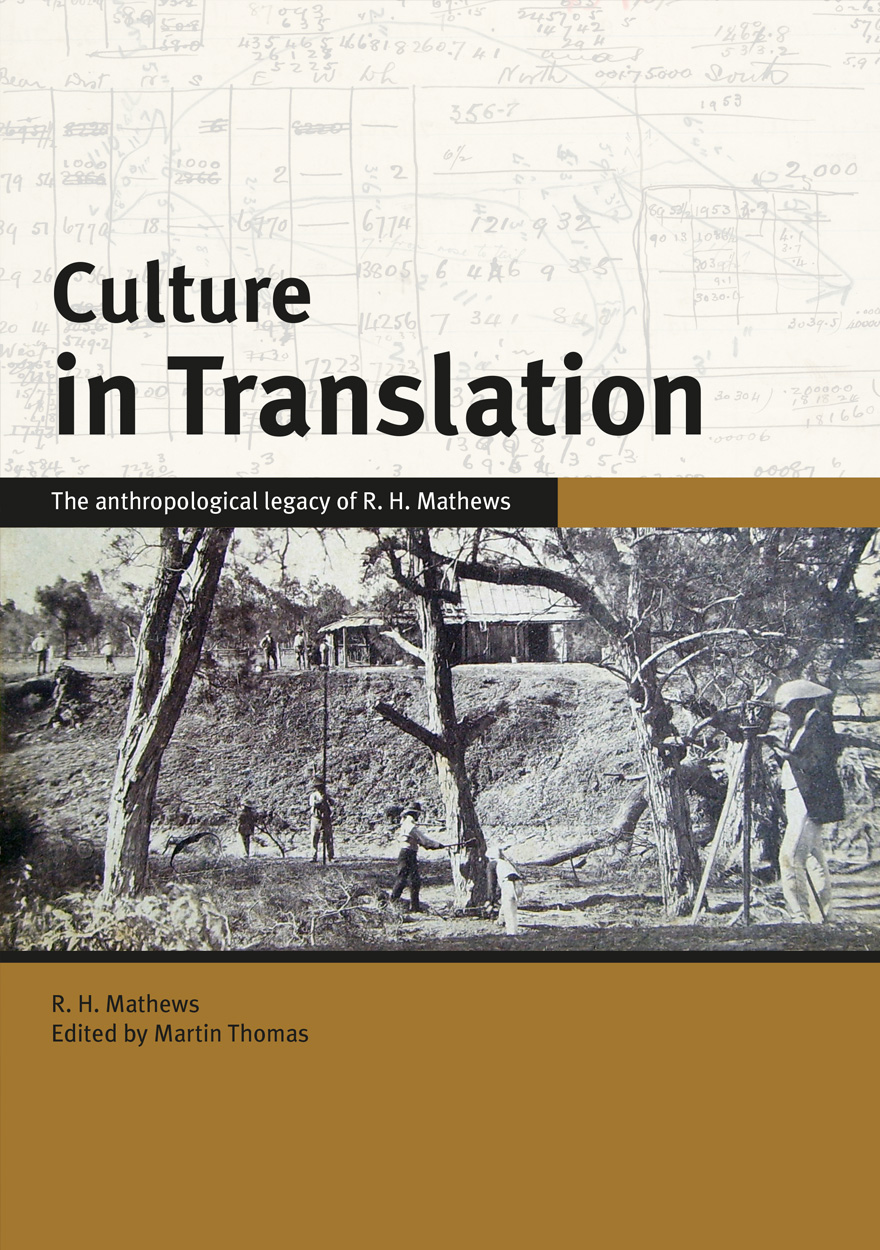
Culture in Translation
The anthropological legacy of R. H. Mathews
Edited by: Martin ThomasPlease read Conditions of use before downloading the formats.
Description
R. H. Mathews (1841–1918) was an Australian-born surveyor and self-taught anthropologist. From 1893 until his death in 1918, he made it his mission to record all ‘new and interesting facts’ about Aboriginal Australia. Despite falling foul with some of the most powerful figures in British and Australian anthropology, Mathews published some 2200 pages of anthropological reportage in English, French and German. His legacy is an outstanding record of Aboriginal culture in the Federation period.
This first edited collection of Mathews’ writings represents the many facets of his research, ranging from kinship study to documentation of myth. It include eleven articles translated from French or German that until now have been unavailable in English. Introduced and edited by Martin Thomas, who compellingly analyses the anthropologist, his milieu, and the intrigues that were so costly to his reputation, Culture in Translation is essential reading on the history of cross-cultural research.
The translations from the French are by Mathilde de Hauteclocque and from the German by Christine Winter.
For more information on Aboriginal History Inc. please visit aboriginalhistory.org.au.
Details
- ISBN (print):
- 9781921313240
- ISBN (online):
- 9781921313257
- Publication date:
- Sep 2007
- Note:
- Aboriginal History Monograph 15
- Imprint:
- ANU Press
- DOI:
- http://doi.org/10.22459/CT.09.2007
- Series:
- Aboriginal History Monographs
- Co-publisher:
- Aboriginal History
- Disciplines:
- Arts & Humanities: Cultural Studies, History; Social Sciences: Anthropology, Indigenous Studies
- Countries:
- Australia
PDF Chapters
Please read Conditions of use before downloading the formats.
- Preliminary Pages (PDF, 183KB)
- Acknowledgements (PDF, 99KB)
- Preface (PDF, 105KB)
- Note on Text (PDF, 126KB)
- Names of Aboriginal Groups and Languages (PDF, 100KB)
- Maps (PDF, 428KB)
- Abbreviations (PDF, 53KB)
Introducing R. H. Mathews
- ‘Birrarak is the name given to me by the natives’ (PDF, 4.6MB) – Martin Thomas
Part 1: Rock Art and Daily Life
- Introduction (PDF, 1.3MB) – Martin Thomas
- Contributions to the Ethnography of the Australians (PDF, 325KB) – R. H. Mathews
- Rock Carvings and Paintings by the Australian Aborigines (PDF, 1.0MB) – R. H. Mathews
- Plan of some Drawings carved or painted on Rock by the Natives of New South Wales, Australia (PDF, 580KB) – R. H. Mathews
Part 2: Kinship and Marriage
- Introduction (PDF, 121KB) – Martin Thomas
- Social Organisation of Some Australian Tribes (PDF, 223KB) – R. H. Mathews
- Remarks on the Natives of Australia (PDF, 243KB) – R. H. Mathews
- The Natives of Australia (PDF, 111KB) – R. H. Mathews
Part 3: Mythology
- Introduction (PDF, 755KB) – Martin Thomas
- Some Mythology of the Gundungurra Tribe, New South Wales (PDF, 176KB) – R. H. Mathews
- A Giant in a Cave—An Australian Legend (PDF, 143KB) – R. H. Mathews
- Australian Folk-Tales (PDF, 180KB) – R. H. Mathews
- The Wareengarry and Karambal (PDF, 100KB) – R. H. Mathews
- The Hereafter (PDF, 103KB) – R. H. Mathews
Part 4: Language
- Introduction (PDF, 747KB) – Martin Thomas
- The Wailwan Language (PDF, 257KB) – R. H. Mathews
- Language of the Kurnu Tribe, New South Wales (PDF, 300KB) – R. H. Mathews
Part 5: Ceremony
- Introduction (PDF, 233KB) – Martin Thomas
- The Mŭltyerra Initiation Ceremony (PDF, 370KB) – R. H. Mathews
- Initiation Ceremony of the Birdhawal Tribe (PDF, 227KB) – R. H. Mathews
- The Bundandaba Ceremony of Initiation in Queensland (PDF, 199KB) – R. H. Mathews
Part 6: Correspondence
- Introduction (PDF, 109KB) – Martin Thomas
- Letters to E. S. Hartland (PDF, 121KB) – R. H. Mathews
- Letters to R. H. Mathews (PDF, 144KB)
- Letter to Moritz von Leonhardi (PDF, 101KB) – R. H. Mathews
- RHM Bibliography (PDF, 214KB)
Other publications that may interest you