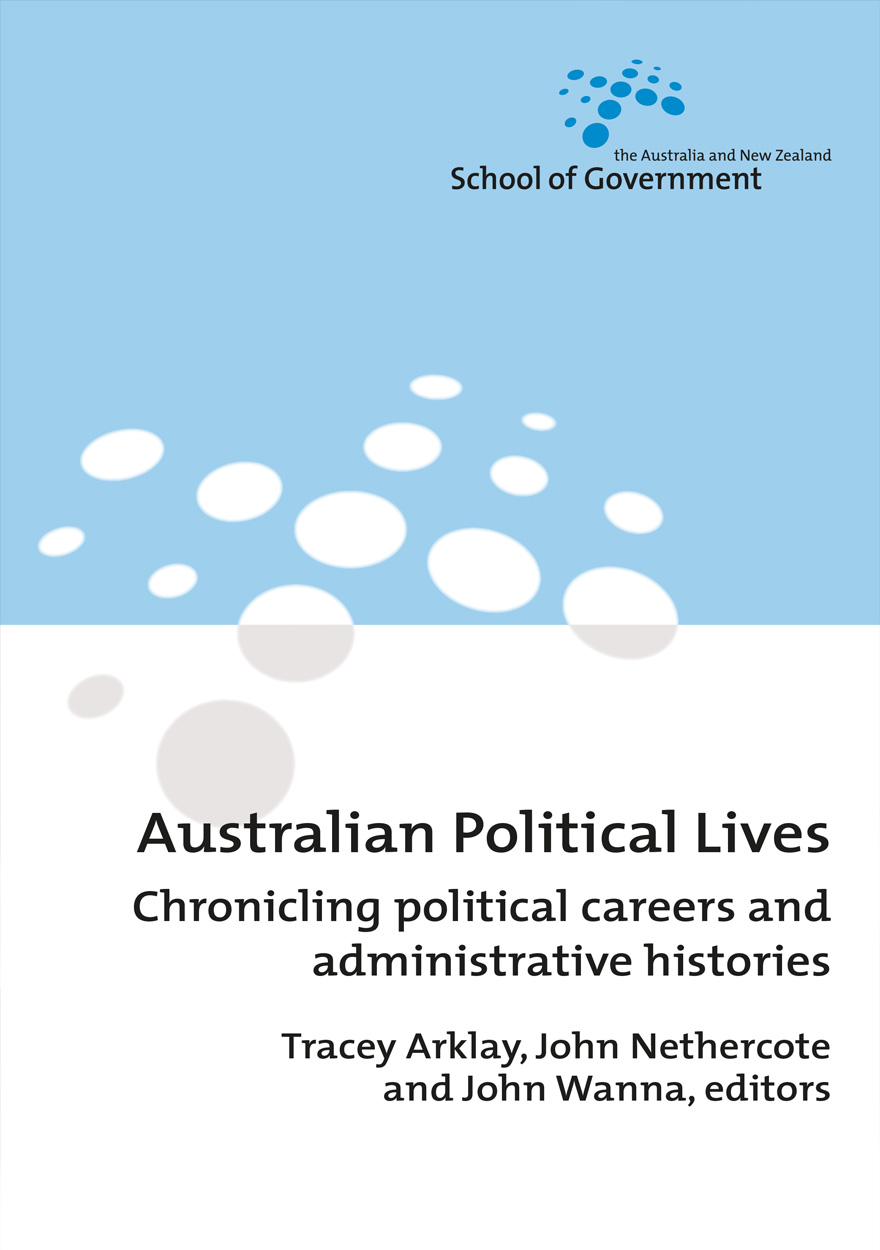
Australian Political Lives
Chronicling political careers and administrative histories
Edited by: Tracey Arklay, John Nethercote, John Wanna
Please read Conditions of use before downloading the formats.
Description
This monograph brings together some of the best practitioners of the art and craft of political biography in Australia. They are simultaneously some of our best scholars who, at least in part, have turned their attention to writing Australian political lives. They are not merely chroniclers of our times but multidisciplinary analysts constructing layers of explanation and theoretical insight. They include academic, professional and amateur biographers; scholars from a range of disciplines (politics, history, sociology, public administration, gender studies); and politicians who for a time strutted the political stage. The assembled papers explore the strengths and weaknesses of the biographical approach; the enjoyment it can deliver; the problems and frustrations of writing biographies; and the various ways the ‘project’ can be approached by those constructing these lives. They probe the art and craft of the political biographer.
Details
- ISBN (print):
- 9781920942731
- ISBN (online):
- 9781920942748
- Publication date:
- Oct 2006
- Imprint:
- ANU Press
- DOI:
- http://doi.org/10.22459/APL.10.2006
- Series:
- Australia and New Zealand School of Government (ANZSOG)
- Co-publisher:
- The Australia and New Zealand School of Government (ANZSOG)
- Disciplines:
- Arts & Humanities: Biography & Autobiography, History; Social Sciences: Indigenous Studies, Politics & International Studies
- Countries:
- Australia
PDF Chapters
Please read Conditions of use before downloading the formats.
If your web browser doesn't automatically open these files, please download a PDF reader application such as the free Adobe Acrobat Reader.
To copy a chapter DOI link, right-click (on a PC) or control+click (on a Mac) and then select ‘Copy link location’.
- The Art of Australian Political Biography (PDF, 160KB) – Geoffrey Bolton doi
- Political Biography: Its Contribution to Political Science (PDF, 145KB) – Tracey Arklay doi
- Recording Non-Labor Politics Through Biography (PDF, 110KB) – Judith Brett doi
- The ‘Life Myth’, ‘Short Lives’ and Dealing with Live Subjects in Political Biography (PDF, 119KB) – James Walter doi
- Public Lives, Private Lives: the Fundamental Dilemma in Political Biography (PDF, 124KB) – Nicholas Brown doi
- Expanding The Repertoire: Theory, Method and Language in Political Biography (PDF, 122KB) – R. A. W. Rhodes doi
- John Curtin: Taking his Childhood Seriously (PDF, 105KB) – David Day doi
- Ministers, Prime Ministers, Mandarins: Politics as a Job (PDF, 114KB) – Patrick Weller doi
- Biography and the Rehabilitation of the Subject: The Case of John Gorton (PDF, 111KB) – Ian Hancock doi
- Aboriginality and Impersonality: Three Australian Indigenous Administrative Memoirs (PDF, 121KB) – Tim Rowse doi
- Writing Political Biography (PDF, 106KB) – Rae Wear doi
- Jessie Street and the New Political Biography (PDF, 111KB) – Lenore Coltheart doi
- Conjuring Fascinating Stories: the Case of Sir Arthur Tange (PDF, 89KB) – Peter Edwards doi
- Anonymous in Life, Anonymous in Death: Memoirs and Biographies of Administrators (PDF, 110KB) – John Nethercote doi
- The Personal Writings of Politicians (PDF, 117KB) – Neal Blewett doi
- Writing Political Autobiographies (PDF, 107KB) – John Button doi
- Political Biographies and Administrative Memoirs: Some Concluding Comments (PDF, 159KB) – Philip A. Selth doi
Other publications that may interest you