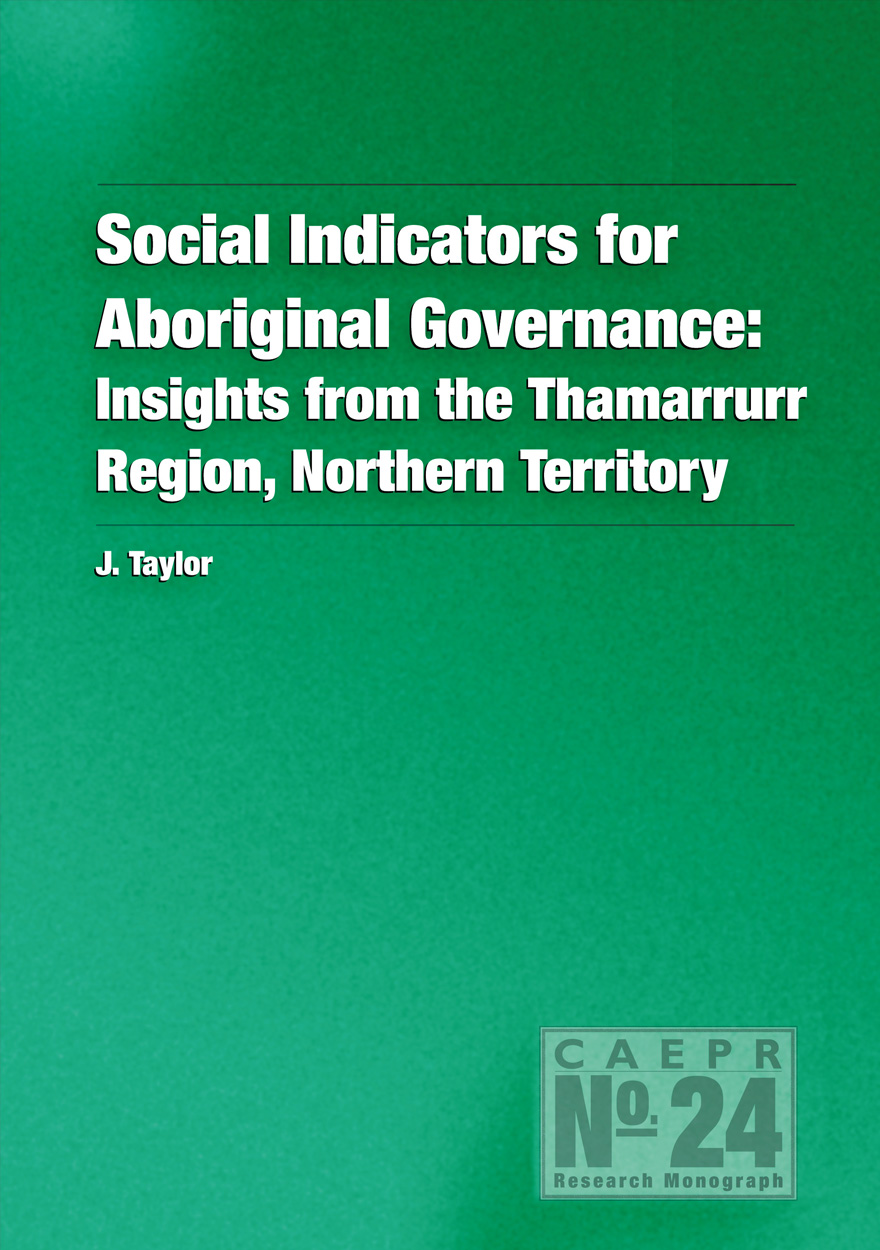
Social Indicators for Aboriginal Governance
Insights from the Thamarrurr Region, Northern Territory
Authored by: John TaylorPlease read Conditions of use before downloading the formats.
Description
John Taylor is a Senior Fellow at the Centre for Aboriginal Economic Policy Research, The Australian National University, Canberra.
The Council of Australian Governments is trialing Indigenous Community Coordination Pilot schemes around the country aimed at fostering whole-of-government approaches to service delivery and development. A notable example is in the Thamarrurr region of the Northern Territory focused on the Aboriginal town of Wadeye and its hinterland. Under new governance arrangements the Thamarrurr Regional Council has identified a need to profile existing social and economic conditions as a basis for its current planning and future evaluation.
This study provides an innovative template for such profiling. With substantial input from local people it uncovers a region of high population growth with major challenges in areas of employment, income, education and training, housing and infrastructure, health status and criminal justice. It yields a baseline of available data to assist discussions of regional needs, aspirations and development capacities. By using population projections, it shifts government and community thinking away from reactive responses to historic need, to a more pro-active future-oriented approach to development.
The Thamarrurr people view this document as an important planning tool for their people. Their aim is to have the same access to services and opportunities as other Australians. “Give every kid a chance” is their catch cry. This study lays out what is required from governments and the community to achieve that vision.
Details
- ISBN (print):
- 9781920942137
- ISBN (online):
- 9781920942120
- Publication date:
- Oct 2004
- Note:
- CAEPR Monograph No. 24
- Imprint:
- ANU Press
- DOI:
- http://doi.org/10.22459/CAEPR24.10.2004
- Series:
- Centre for Aboriginal Economic Policy Research (CAEPR)
- Co-publisher:
- Centre for Aboriginal Economic Policy Research (CAEPR)
- Disciplines:
- Social Sciences: Indigenous Studies, Social Policy & Administration
- Countries:
- Australia
PDF Chapters
Social Indicators for Aboriginal Governance »
Please read Conditions of use before downloading the formats.
- Background and conceptual issues (PDF, 697KB)
- Demography of the Thamarrurr region (PDF, 1.4MB)
- The regional labour market (PDF, 997KB)
- Income from employment and welfare (PDF, 159KB)
- Education and training (PDF, 414KB)
- Housing and infrastructure (PDF, 281KB)
- Health status (PDF, 535KB)
- Regional involvement in the criminal justice system (PDF, 269KB)
- Implications for regional planning (PDF, 179KB)
Other publications that may interest you