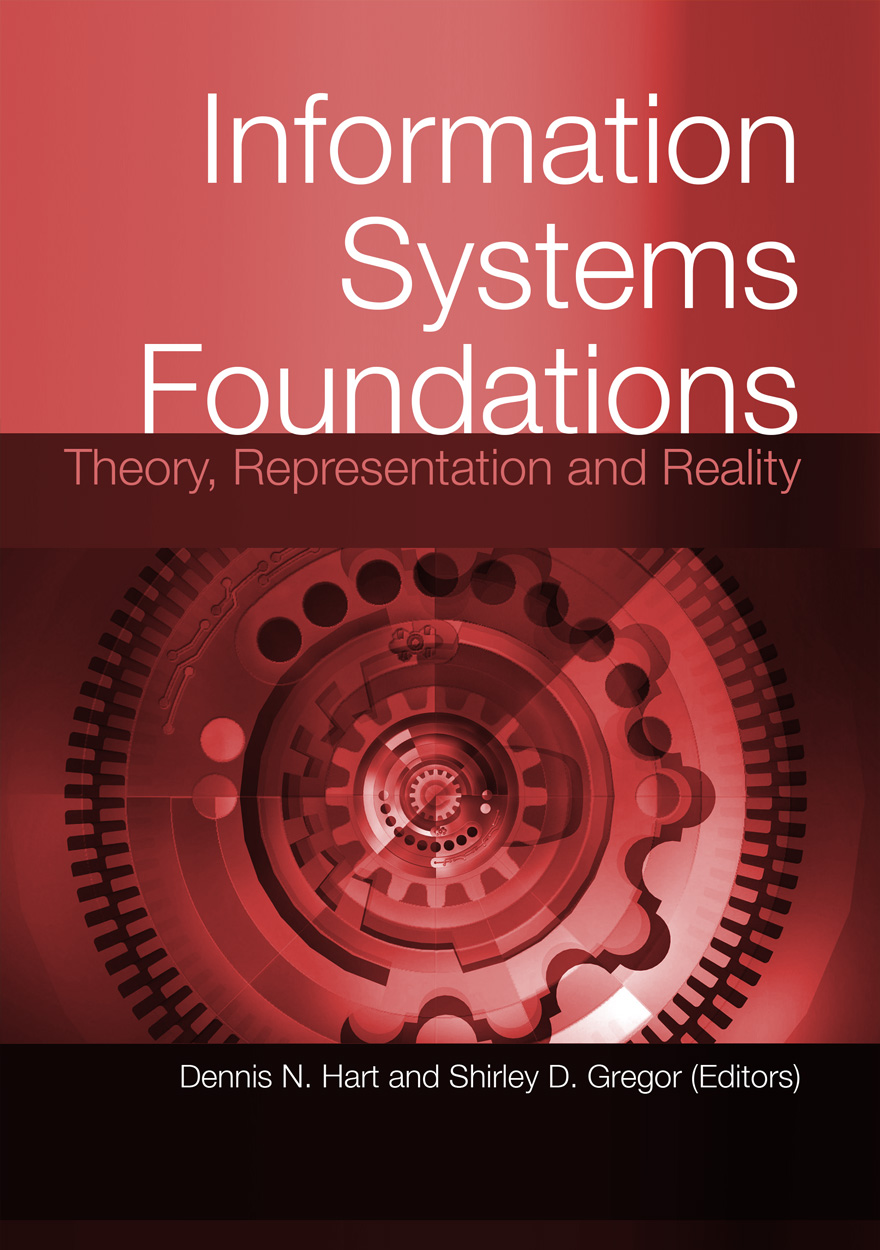
Information Systems Foundations: Theory, Representation and Reality
Edited by: Dennis Hart, Shirley Gregor
Please read Conditions of use before downloading the formats.
Description
This volume contains the papers presented at the third biennial Information Systems Foundations (‘Theory, Representation and Reality’) Workshop, held at The Australian National University in Canberra from 27-28 September 2006. The focus of the workshop was, as for the others in the series, the foundations of Information Systems as an academic discipline. The particular emphasis was, as in past workshops, the adequacy and completeness of theoretical underpinnings and the research methods employed. At the same time the practical nature of the applications and phenomena with which the discipline deals were kept firmly in view. Accordingly, the papers in this volume range from the unashamedly theoretical n their focus (Designing for Mutability in Information Systems Artifacts; Towards a Unified Theory of Fit: Task, Technology and Individual) to the much more practically oriented (An Action-Centred Approach to Conceptualising Information Support for Routine Work).
The contents of this volume will be of interest and relevance to academics and advanced students as well as thoughtful and reflective practitioners in the Information Systems field.
Details
- ISBN (print):
- 9781921313134
- ISBN (online):
- 9781921313141
- Publication date:
- Nov 2007
- Imprint:
- ANU Press
- DOI:
- http://doi.org/10.22459/ISFTRR.11.2007
- Series:
- Information Systems Foundations
- Disciplines:
- Business & Economics; Engineering & Computer Science: Computer Science & Information Systems
PDF Chapters
Information Systems Foundations: Theory, Representation and Reality »
Please read Conditions of use before downloading the formats.
If your web browser doesn't automatically open these files, please download a PDF reader application such as the free Adobe Acrobat Reader.
To copy a chapter DOI link, right-click (on a PC) or control+click (on a Mac) and then select ‘Copy link location’.
Theory
- Designing for Mutability in Information Systems Artifacts (PDF, 216KB) – Shirley Gregor and Juhani Iivari doi
- The Effect of the Application Domain in IS Problem Solving: A Theoretical Analysis (PDF, 341KB) – Iris Vessey doi
- Towards a Unified Theory of Fit: Task, Technology and Individual (PDF, 366KB) – Michael J. Davern doi
- Are Routine Manual Systems Genuine Information Systems? (PDF, 145KB) – Reeva Lederman and Robert Johnston doi
Representation
- Extending the Scope of Representation Theory: A Review and Proposed Research Model (PDF, 359KB) – Jan Recker, Michael Rosemann, Peter Green and Marta Indulska doi
- Indexing Research: An Approach to Grounding Ingarden’s Ontological Framework (PDF, 385KB) – John W Lamp and Simon Milton doi
- Using Protocol Analysis to Explore the Creative Requirements Engineering Process (PDF, 145KB) – Lemai Nguyen and Graeme Shanks doi
- Poles Apart or Bedfellows? Re-conceptualising Information Systems Success and Failure (PDF, 217KB) – Dennis Hart and Leoni Warne doi
Reality
- An Action-Centred Approach to Conceptualising Information Support for Routine Work (PDF, 417KB) – Vivienne Waller, Robert B Johnston and Simon K Milton doi
- Emergent Conversational Technologies That Are Democratising Information Systems in Organisations: The Case of the Corporate Wiki (PDF, 134KB) – Helen Hason and Charmaine C Pfaff doi
- A Road Less Travelled: Exploratory Practice-Driven Theory Development Opportunities in IS Project Management (PDF, 289KB) – Peter Reynolds and Peter Yetton doi
- A Multi-Paradigm Approach to Grounded Theory (PDF, 348KB) – Walter Fernandez, Michael A Martin, Shirley Gregor, Steven E Stern and Michael Vitale doi
- The Methodological and Theoretical Foundations of Decision Support Systems Research (PDF, 144KB) – David Arnott and Graham Pervan doi
Other publications that may interest you