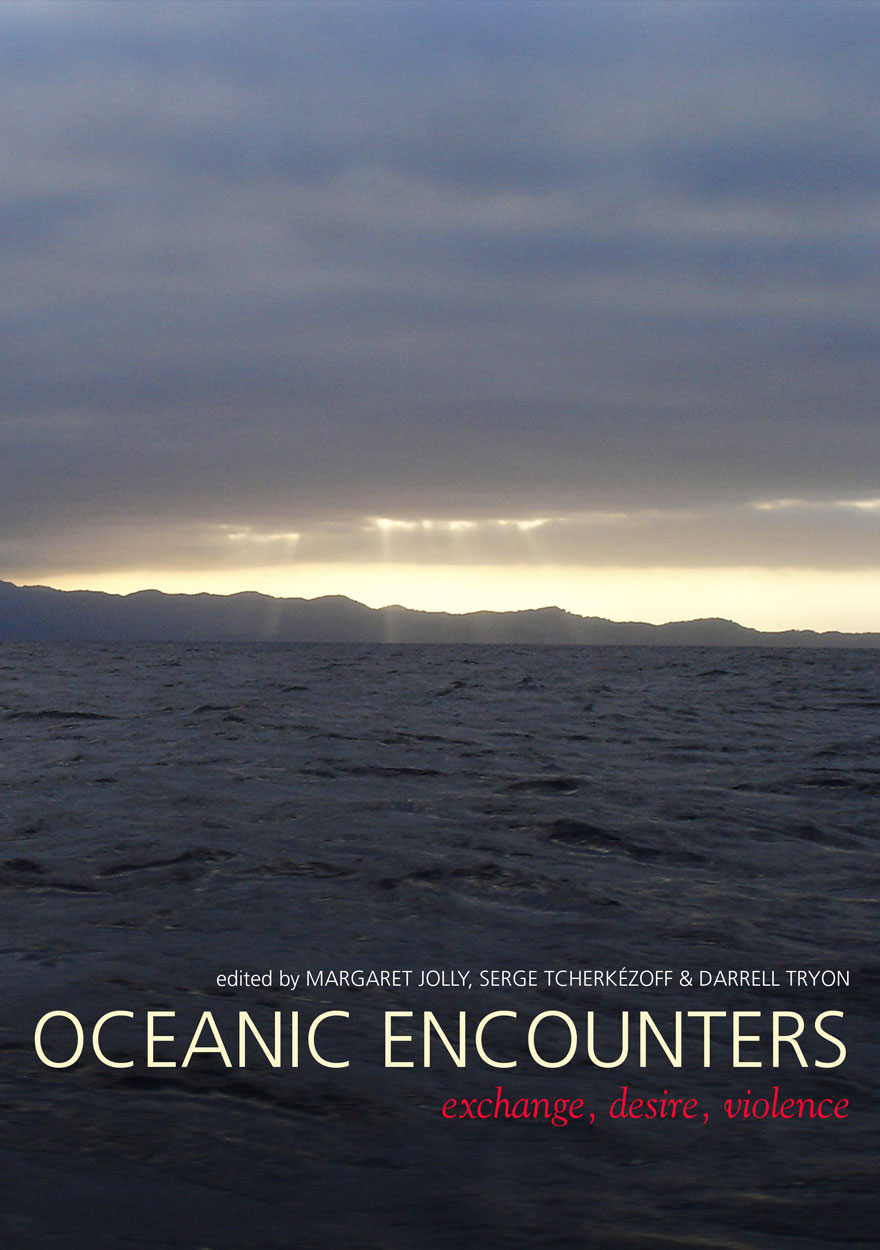
Oceanic Encounters
Exchange, Desire, Violence
Edited by: Margaret Jolly , Serge Tcherkézoff, Darrell Tryon
Please read Conditions of use before downloading the formats.
Description
This volume, the result of ongoing collaborations between Australian and French anthropologists, historians and linguists, explores encounters between Pacific peoples and foreigners during the longue durée of European exploration, colonisation and settlement from the sixteenth century to the twentieth century. It deploys the concept of ‘encounter’ rather than the more common idea of ‘first contact’ for several reasons. Encounters with Europeans occurred in the context of extensive prior encounters and exchanges between Pacific peoples, manifest in the distribution of languages and objects and in patterns of human settlement and movement. The concept of encounter highlights the mutuality in such meetings of bodies and minds, whereby preconceptions from both sides were brought into confrontation, dialogue, mutual influence and ultimately mutual transformation. It stresses not so much prior visions of ‘strangers’ or ‘others’ but the contingencies in events of encounter and how senses other than vision were crucial in shaping reciprocal appraisals. But a stress on mutual meanings and interdependent agencies in such cross-cultural encounters should not occlude the tumultuous misunderstandings, political contests and extreme violence which also characterised Indigenous-European interactions over this period.
Details
- ISBN (print):
- 9781921536281
- ISBN (online):
- 9781921536298
- Publication date:
- Jul 2009
- Imprint:
- ANU Press
- DOI:
- http://doi.org/10.22459/OE.07.2009
- Disciplines:
- Arts & Humanities: Cultural Studies, History; Social Sciences: Anthropology
- Countries:
- Pacific: Papua New Guinea, Tonga, Vanuatu
PDF Chapters
Please read Conditions of use before downloading the formats.
If your web browser doesn't automatically open these files, please download a PDF reader application such as the free Adobe Acrobat Reader.
To copy a chapter DOI link, right-click (on a PC) or control+click (on a Mac) and then select ‘Copy link location’.
- Preface (PDF, 110KB)
- Acknowledgements (PDF, 109KB)
- Contributors (PDF, 159KB)
- List of Figures and Tables (PDF, 108KB)
- List of abbreviations and acronyms (PDF, 59KB)
- Oceanic Encounters: A Prelude (PDF, 600KB) – Margaret Jolly and Serge Tcherkézoff doi
- Linguistic Encounter and Responses in the South Pacific (PDF, 492KB) – Darrell Tryon doi
- The Sediment of Voyages: Re-membering Quirós, Bougainville and Cook in Vanuatu (PDF, 1.3MB) – Margaret Jolly doi
- A Reconsideration of the Role of Polynesian Women in Early Encounters with Europeans: Supplement to Marshall Sahlins’ Voyage around the Islands of History (PDF, 230KB) – Serge Tcherkézoff doi
- Uncertain Times: Sailors, Beachcombers and Castaways as “Missionaries” and Cultural Mediators in Tonga (Polynesia) (PDF, 138KB) – Françoise Douaire-Marsaudon doi
- In the Event: Indigenous Countersigns and the Ethnohistory of Voyaging (PDF, 1.4MB) – Bronwen Douglas doi
- Watkin Tench’s Fieldwork: The Journal of an “Ethnographer” in Port Jackson, 1788-1791 (PDF, 160KB) – Isabelle Merle doi
- The Art of Encounter: Verisimilitude in the Imaginary Exploration of Interior New Guinea, 1725–1876 (PDF, 489KB) – Chris Ballard doi
- Black Powder, White Magic: European Armaments and Sorcery in Early Mekeo and Roro Encounters (PDF, 193KB) – Mark S. Mosko doi
- A Measure of Violence: Forty Years of “First Contact” Among the Ankave-Anga (Papua New Guinea) (PDF, 509KB) – Pascale Bonnemère and Pierre Lemonnier doi
Other publications that may interest you