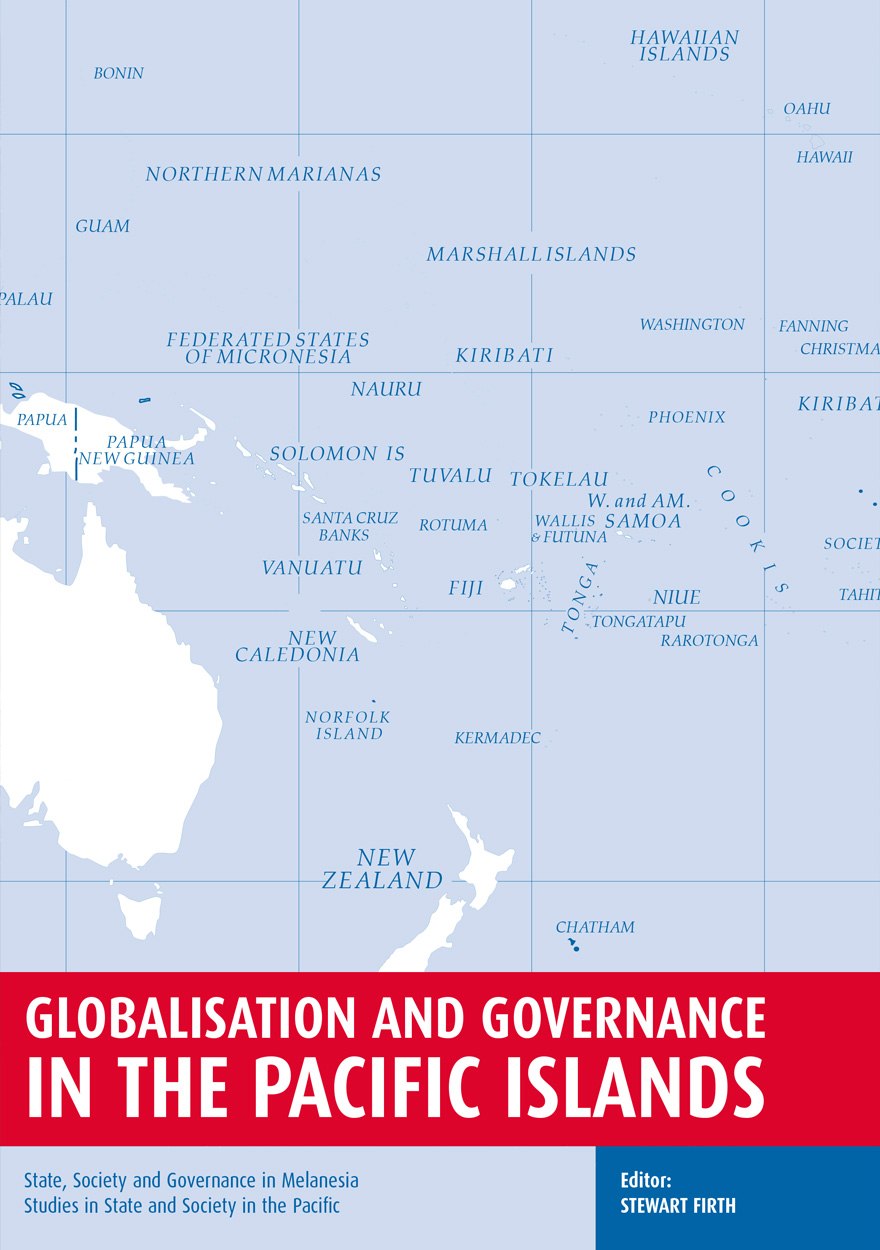
Globalisation and Governance in the Pacific Islands
State, Society and Governance in Melanesia
Edited by: Stewart Firth
Please read Conditions of use before downloading the formats.
Description
The Pacific Islands are feeling the effects of globalisation. Free trade in sugar and garments is threatening two of Fiji’s key industries. At the same time other opportunities are emerging. Labour migration is growing in importance, and Pacific governments are calling for more access to Australia’s labour market. Fiji has joined Samoa, Tonga, Tuvalu and Kiribati as a remittance economy, with thousands of its citizens working overseas. Meantime, Papua New Guinea and Solomon Islands grapple with an older kind of globalisation in which overseas companies exploit mineral and forest resources.
The Pacific Islands confront unique problems of governance in this era of globalisation. The modern, democratic state often fits awkwardly with traditional ways of doing politics in that part of the world. Just as often, politicians in the Pacific exploit tradition or invent it to serve modern political purposes.
The contributors to this volume examine Pacific globalisation and governance from a wide range of perspectives. They come from Papua New Guinea, Solomon Islands, Hawai’i, the Federated States of Micronesia, Samoa, Fiji, New Zealand and Jamaica as well as Australia.
Details
- ISBN (print):
- 9781920942977
- ISBN (online):
- 9781920942984
- Publication date:
- Dec 2006
- Note:
- Studies in State and Society in the Pacific, No. 1
- Imprint:
- ANU Press
- DOI:
- http://doi.org/10.22459/GGPI.12.2006
- Series:
- State, Society and Governance in Melanesia
- Disciplines:
- Arts & Humanities: Cultural Studies; Business & Economics; Social Sciences: Development Studies, Politics & International Studies, Social Policy & Administration
- Countries:
- Australia; Pacific: Fiji, Papua New Guinea, Tonga, Solomon Islands, Samoa
PDF Chapters
Globalisation and Governance in the Pacific Islands »
Please read Conditions of use before downloading the formats.
If your web browser doesn't automatically open these files, please download a PDF reader application such as the free Adobe Acrobat Reader.
To copy a chapter DOI link, right-click (on a PC) or control+click (on a Mac) and then select ‘Copy link location’.
- Keynote Address — From Neo-Liberalism to the New Medievalism (PDF, 173KB) – John Rapley doi
- Treading Water in Rapids? Non-Governmental Organisations and Resistance to Neo-Liberalism in Pacific Island States (PDF, 197KB) – Claire Slatter doi
- Regionalism and Cultural Identity: Putting the Pacific back into the plan (PDF, 160KB) – Elise Huffer doi
Labour Migration
- Migration, Dependency and Inequality in the Pacific: Old Wine in Bigger Bottles? (Part 1) (PDF, 202KB) – John Connell doi
- Migration, Dependency and Inequality in the Pacific: Old Wine in Bigger Bottles? (Part 2) (PDF, 216KB) – John Connell doi
- Globalisation, New Labour Migration and Development in Fiji (PDF, 162KB) – Manoranjan Mohanty doi
- ‘Tonga Only Wants Our Money’: The children of Tongan migrants (PDF, 169KB) – Helen Lee doi
- Labour Mobility in the Pacific: Creating seasonal work programs in Australia (PDF, 271KB) – Nic Maclellan and Peter Mares doi
- Contemporary Migration Within the Pacific Islands: The case of Fijian skilled workers in Kiribati and Marshall Islands (PDF, 174KB) – Avelina Rokoduru doi
Sugar and Garments
- Fiji: Sugar and sweatshirts, migrants and remittances (PDF, 298KB) – Kate Hannan doi
- End of the Line? Globalisation and Fiji’s Garment Industry (PDF, 196KB) – Donovan Storey doi
Corporate and State Governance in Mining and Forestry
- Global Capital and Local Ownership in Solomon Islands’ Forestry Industry Tarcisius (PDF, 377KB) – Tara Kabutaulaka doi
- Mining, Social Change and Corporate Social Responsibility: Drawing lines in the Papua New Guinea mud (PDF, 174KB) – Glenn Banks doi
- The ‘Resource Curse’ and Governance: A Papua New Guinean perspective (PDF, 151KB) – Mel Togolo doi
Tradition, Culture and Politics
- Keynote Address — Governance in Fiji: The interplay between indigenous tradition, culture and politics (PDF, 137KB) – Ratu Joni Madraiwiwi doi
- The State of the State in Fiji: Some failings in the periphery (PDF, 190KB) – Vijay Naidu doi
- Power Sharing in Fiji and New Caledonia (PDF, 255KB) – Jon Fraenkel doi
- More Than 20 Years of Political Stability in Samoa under the Human Rights Protection Party (PDF, 186KB) – Asofou So’o doi
- Matai Titles and Modern Corruption in Samoa: Costs, expectations and consequences for families and society (PDF, 152KB) – A. Morgan Tuimaleali’ifano doi
Media, Civil Society and Democracy
- Keynote Address — Keeping the Information Flow Open: A key condition for good government in Micronesia (PDF, 147KB) – Father Francis X. Hezel doi
- Governance, Globalisation and the PNG Media: A survival dilemma (PDF, 165KB) – Joe R. Kanekane doi
- Democracy in Papua New Guinea: Challenges from a rights-based approach (PDF, 139KB) – Orovu Sepoe doi
- Governance and Livelihood Realities in Solomon Islands (PDF, 137KB) – Morgan Wairiu doi
Other publications that may interest you